
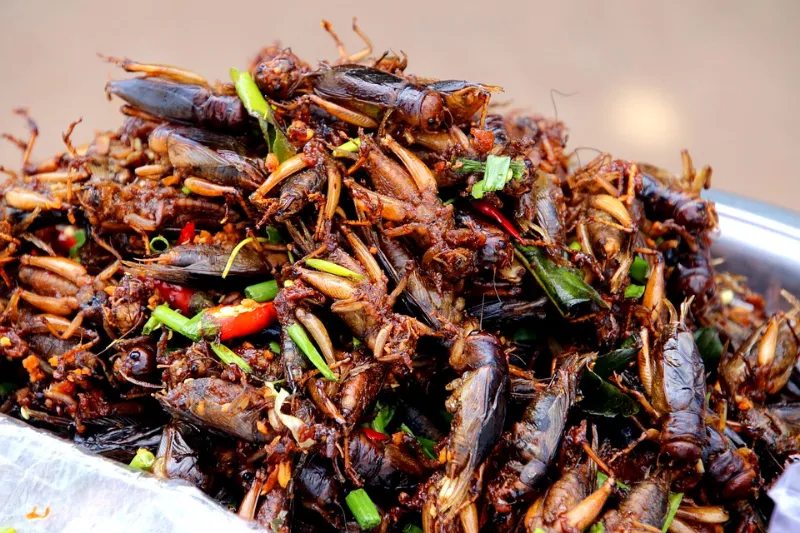
Forget macarons. The food of our future has six legs and antennae.
Finding environmentally friendly and sustainable sources of protein is certainly among the most pressing issues of the early 21st century. The main reasons are the growing population and ever-increasing demands on livestock production, which cannot be met in the long term. One of the promising alternatives currently being considered is insects. Insects are known as a source of high-quality protein and therefore form a more or less significant part of the diet in more than 100 countries around the world. Their nutritional value, however, is not constant but depends on many factors, including the species, diet and sex of the individual insect. Knowing which factors affect the nutritional composition of insects is therefore one of the key prerequisites for successfully optimising insect farming technology for subsequent processing in the food or feed industry.
A team of experts from our faculty has described the effect of the developmental stage of insects on the quantity and quality of the basic nutrients they contain. The model species for this experiment were the cockroach Blaberus craniifer and superworms (Zophobas morio). No significant difference in basic nutrient content or protein quality (expressed as essential amino acid indices) was found between superworm larvae harvested at 60, 90 and 120 days of age. In B. craniifer cockroaches, on the other hand, adults contained significantly more protein and less fat than nymphs of the same species. Calculations of the atherogenicity index (risky deposition of fatty substances) and the thrombogenicity index (the capacity to cause thrombosis) showed that fat quality increased with age in cockroaches, whereas in the worms it decreased.
The results of this work thus confirmed that the current developmental stage of insects has a marked effect on their nutritional value, although the differences between individual larval stages are not as large as those between juvenile and adult insects. The findings are valuable not only for the scientific community working on the nutritional quality of food but also for edible insect farmers. By timing the harvest to a particular developmental stage, they can produce edible insects with the nutritional parameters required by processors or consumers.
Original paper:
KULMA, Martin, Lenka KOUŘIMSKÁ, Dana HOMOLKOVÁ, Matěj BOŽIK, Vladimír PLACHÝ a Vladimír VRABEC. Effect of developmental stage on the nutritional value of edible insects. A case study with Blaberus craniifer and Zophobas morio. Journal of Food Composition and Analysis [online]. 2020, 92 [cit. 2020-11-19]. ISSN 08891575. Dostupné z: doi:10.1016/j.jfca.2020.103570
Ing. Martin Kulma, Ph.D.
Position
Ing. and Ph.D. in General Animal Science at the Department of Zoology and Fisheries, CZU main research areas: entomophagy (insect rearing methods; nutritional value, acceptance and sensory properties); insect ecology (monitoring of butterflies, mosquitoes and invasive insect species); medical and veterinary entomology (bionomics of pathogen vectors, effectiveness of alternative repellents and biopesticides). about me: I have a kind wife, a yappy dog and I am always late free time: I like hiking in the mountains with a rucksack on my back, sleeping under the stars and making model cars, and I also like spicy food and beer
prof. Ing. Lenka Kouřimská, Ph.D.
Co-author
Ing. and Ph.D. in Food Chemistry and Analysis at the University of Chemistry and Technology, Prague (VŠCHT), habilitation at CZU in the quality of agricultural products main research areas: food chemistry and analysis, food quality and safety (recently mainly the nutritional and sensory quality of edible insects and insects as a novel food), lipid oxidation and natural antioxidants, sensory changes in agricultural products during processing and storage, food commodity science about me: I have a caring husband, two sons (both following in their mum’s footsteps in food quality and nutrition, studying at CZU and VŠCHT respectively), a cat and a colony of Australian stick insects free time: my husband and I share a love of ballroom dancing, and I enjoy hiking and discovering the fauna and flora of the Czech Republic and other countries