
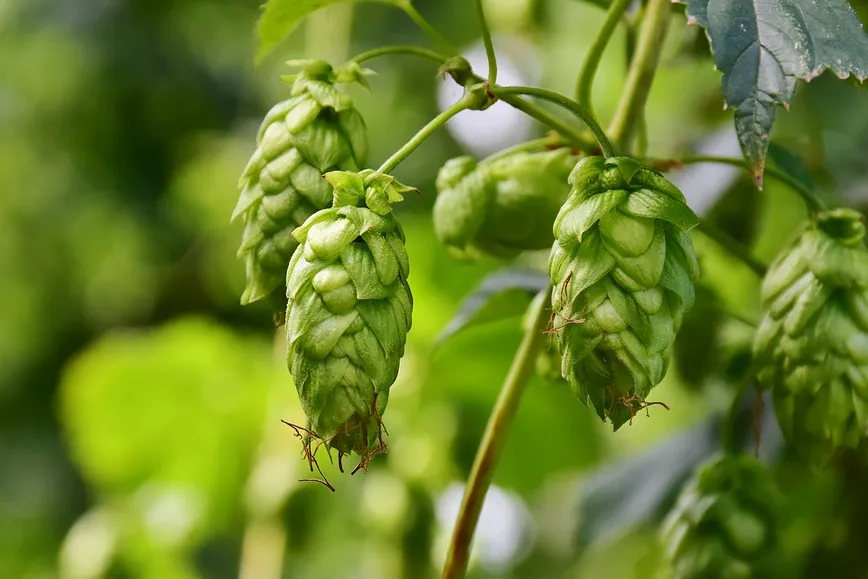
Could extreme weather threaten the production of this popular drink too?
Climate events can have various effects on the overall yield and bitterness of hops. We may encounter combinations of events in which only one variable is extreme, but also events in which two extreme variables occur at the same time (for example drought and a heatwave). Drought also contributes to high temperatures and the development of heatwaves. Over the last 20 years, a feedback loop has formed between soil temperature and near-surface air temperature: warmer soil heats the atmosphere and a warmer atmosphere heats the soil, which sustains the rise in atmospheric temperature. The increasing frequency of heatwaves and droughts in hop-growing regions is making income from beer production increasingly unstable, affecting the main hop growers throughout Europe.
A recent study by several of our scientists examined the vulnerability of hop production to compound climate and weather events in Europe, focusing, for example, on identifying how the duration of heatwaves and droughts affects yield reductions. It is the first study of its kind. It covers key hop-growing regions across the European Union, such as Hallertau (Germany); Ústecko, Žatecko and Tršicko (Czech Republic); Kent (United Kingdom); Alsace (France); Lublin (Poland); Koroška (Slovenia) and León and Galicia (Spain).
Using models, the scientists determined the probable distributions of daily precipitation and maximum temperatures, which are used to assess the risks of concurrent droughts and heatwaves during the hop season. They then estimated the risks of lower hop cone yields in the target regions. The results show that longer and more severe periods of drought and heat occur more often than similar shorter periods. The highest level of risk was estimated for the extensive hop-growing regions of the Czech Republic and Germany. In total, 22.4 %, 12.5 % and 7.2 % of EU areas used for commercial hop production fell into the categories of moderate, high and very high risk of yield loss. An analysis of total damage between April and August further indicated that more than 62.7 % of yield losses were caused by high temperatures during drought, and 21.5 % of losses were caused by dry and cold conditions in the regions concerned. Warmer European droughts also reduced yields of high-quality aroma hops by 29 to 68 %. This suggests that hop yields are highly sensitive to these climate events, mainly because hops adapt more slowly than field crops.
POTOPOVÁ, Vera, Ondřej LHOTKA, Martin MOŽNÝ a Marie MUSIOLKOVÁ. Vulnerability of hop‐yields due to compound drought and heat events over European key‐hop regions. International Journal of Climatology [online]. [cit. 2020-11-19]. ISSN 0899-8418. Dostupné z: doi:10.1002/joc.6836
Not good news for beer drinkers!https://www.rmets.org/node/417841
doc. Dr. Mgr. Vera Potopová
Author of the research paper
Vera Potopová graduated in Geography and Biology from the Faculty of Geography at Tiraspol State University in the Republic of Moldova. She completed her doctoral studies in Meteorology, Climatology and Agrometeorology in 2002 at the Climatology Department of the Institute of Geography of the Academy of Sciences of Moldova (ASM). After graduating, she worked at the ASM as a researcher in climatology. In 2005 she was selected for a pilot project run by the Ministry of Labour and Social Affairs of the Czech Republic: “Active Selection of Qualified Foreign Workers”. Since 2006 she has worked at the Department of Agroecology and Crop Production, FAFNR, CZU. Her recent work has focused on the climatology of drought and its impacts on agriculture, water management, the economy and society (migration, human health and quality of life), and she applies her findings to validating and calibrating growth models for modelling the yield parameters of thermophilic vegetables under changing climate conditions.