Basic information
Sensory laboratory
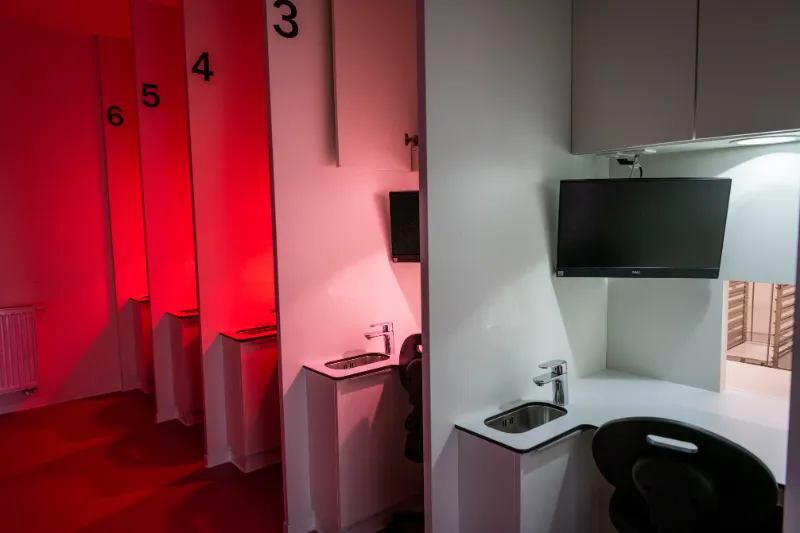
The sensory laboratory introduces students of food quality and nutrition programmes to classic and modern methods of food quality assessment. Its ten tasting booths are used to evaluate food and products from the university farm, gardens, orchards and the Food Pavilion.
Not only nutritional and hygienic value but also sensory quality (taste, smell, texture and appearance) decides whether a product succeeds on the market. The booths prevent assessors from communicating and influencing each other. Each has a serving hatch, water supply, sink, separate lighting and a folding LED panel for coloured lighting and backlighting of samples.
The laboratory works to ISO standards. Assessment forms are filled in online on tablets and evaluated in specialised Compusense software. Samples are prepared in a separate room of the experimental kitchen, where they can be heated or otherwise prepared.
For professionals
What we offer
Laboratory sensory methods include classic tests standardised by ISO norms as well as modern rapid methods.
Trained assessor panel
Assessors trained for analytical tests.
Difference tests
Determine whether a difference between samples is perceived at a given significance level.
Descriptive methods
Identify the nature of a sensory perception and compare and quantify the size of differences.
Consumer tests
Information on acceptability, liking and consumer preferences (hedonic and preference methods).
Rapid methods
Flash Profile and CATA (verbal), Sorting task and Projective mapping (non-verbal): less time and lower training costs, with results in the form of sensory maps.
How it works
Samples in the booths are assessed by
Appearance
For meat products, for example, homogeneity or degree of graininess, the pattern of the inlay, colour of the cut surface and cohesion. The colour intensity of several samples can be compared with a ranking test.
Smell
Assessed for food, cosmetics and packaging materials. In so-called sniffing, the bottle with the sample is shaken and the vapour inhaled sharply; the next sample after at least 30 seconds.
Texture
Mechanical, geometric and surface properties: touch reveals whether a sample is smooth, soft or elastic; biting and chewing reveal firmness, viscosity and solid particles.
Taste
Saltiness, sweetness, sourness, bitterness and seasoning; for drinks such as beer and wine, a rich range of olfactory and taste perceptions.
Team
Our experts
Learn to assess food quality with all your senses.